Canonical URL Checker
Check canonical declarations and available target checks.
Why did Google choose a different canonical?
Compare the two pages before consolidating them. A tracking parameter may create a duplicate; a translation or useful filtered category may need its own canonical URL.
What to do step by step
- Compare the variants and identify their purpose.
- Provide one consistent canonical declaration in head.
- Verify the destination exists and is not unintentionally noindex.
- Link internally and through the sitemap to the preferred version.
- Compare source HTML with the selected canonical in Search Console.
How to fix duplicate canonical tags
Teaching example; example.com addresses are illustrative.
Before
<link rel="canonical" href="https://example.com/bikes">
<link rel="canonical" href="https://example.com/bike">
After
<link rel="canonical" href="https://example.com/bike">The canonical-single check flags two declarations. Removing the duplicate template output leaves one. Then verify that the target loads and represents the same content.
A common mistake
Canonicalising every product to the homepage can erase the signal of its distinct purpose. A single well-formed tag does not prove that its destination is appropriate.
Try the report before checking your site.
Explore the sample report, then enter your own URL to see findings, HTML evidence and a repair plan for your page.
Run your audit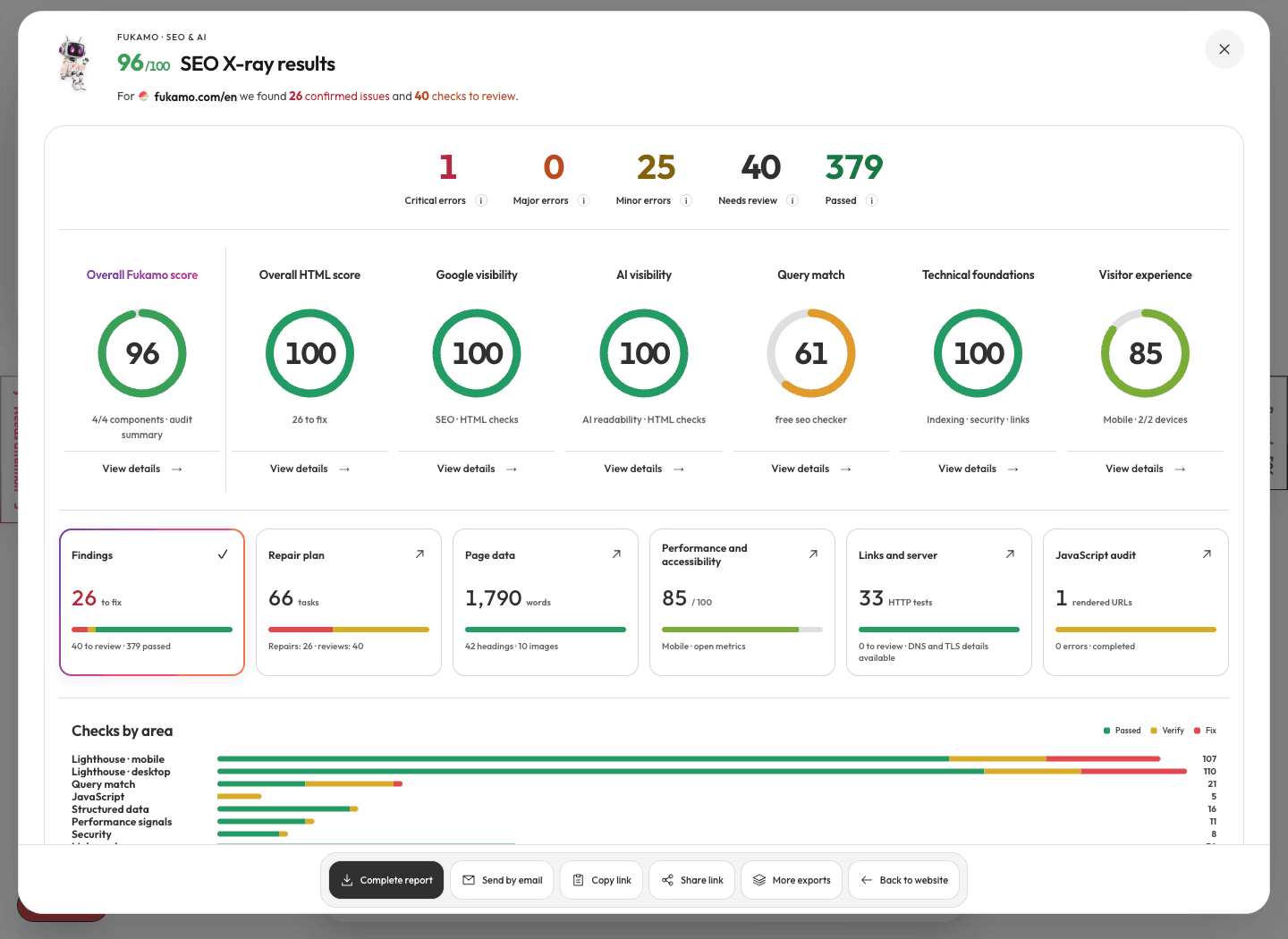
When filters and parameters create duplicate content
A campaign parameter may leave a product unchanged. A filter selecting a different compatible part may change what a customer can buy. Compare the main content before choosing a canonical.
- Group tracking variants with the clean product when their content is equivalent.
- Keep a distinct article or translated page independently identifiable.
- Do not point every pagination page at page one when they list different items.
When to use a canonical tag or a redirect
A canonical expresses a preference while leaving the alternative accessible. A redirect moves the visitor. Choose according to the browsing behavior you need.
- Retain a useful parameter variant with a consistent canonical.
- For a permanent move, redirect to the relevant replacement.
- Check that the preferred destination loads and is not unintentionally noindex.
How to fix conflicting canonical declarations
If a template and plugin disagree, adding a third tag creates more ambiguity. Inspect the public HTML and HTTP Link header to find the source of each declaration.
- Keep one owner for canonical generation in each template.
- Test direct entry and client-side navigation between two products.
- Check that production URLs never inherit a staging host.
How to check Google’s selected canonical URL
A clean tag is a technical result. Google’s selected canonical is a later indexing decision; a declaration alone does not prove it changed.
- Align internal links and the XML sitemap with the preferred URL.
- Inspect both a clean URL and its tracking variant after the fix.
- Compare the selected canonical and last crawl date in Search Console.
How to verify the result
Compare a tracking-parameter URL with its clean equivalent. For distinct content, expect a suitable independent canonical. Use Search Console to confirm the engine’s actual selection.
Primary documentation developers.google.com ↗
Frequently asked questions
Why did Google choose a different canonical?
A canonical is a signal, not a command. Check that the preferred destination works, contains equivalent content, and is not noindex. Align internal links, sitemaps, and redirects. Do not canonicalize fully translated pages to a single language merely because they discuss the same subject.
When the task is complete
The production response declares one intended canonical without a conflicting HTTP header. Track Google’s selected canonical separately; its recorded choice may change only after recrawling and processing.
Related SEO guides
Check a specific page.
Fukamo shows findings, evidence and the next step.
679 rules + SEO, AI readability, performance and accessibility measurements for free.