Structured Data Checker
Check JSON-LD syntax and supported schema types and properties.
Why did valid JSON-LD not produce a rich result?
Identify the page’s actual subject, then choose a type and verify that you have accurate property values. Do not choose schema solely for the appearance of a desired search result.
For JSON-LD inserted by JavaScript, compare server and rendered output. Check the canonical URL referenced by the entity and match prices to the visible product. Open Graph controls the sharing card separately; valid JSON-LD will not supply its missing image.
What to do step by step
- Identify the main subject and suitable type.
- Validate JSON and the properties required for the intended feature.
- Compare names, prices and URLs with visible content.
- Check for conflicting declarations from multiple plugins.
- Use the appropriate validator and monitor Search Console.
How to fix a JSON-LD syntax error
Teaching example; example.com addresses are illustrative.
Before
<script type="application/ld+json">
{"@context":"https://schema.org","@type":"WebPage","name":"Bicycle repair",}
</script>
After
<script type="application/ld+json">
{"@context":"https://schema.org","@type":"WebPage","name":"Bicycle repair"}
</script>
The schema-json check identifies the first block as unparseable. Removing the trailing comma makes it readable. Then check the type’s properties against the visible page content.
A common mistake
Valid JSON does not establish eligibility. Schema.org includes types without corresponding Google rich results. Do not invent reviews, authors or awards to fill fields.
Try the report before checking your site.
Explore the sample report, then enter your own URL to see findings, HTML evidence and a repair plan for your page.
Run your audit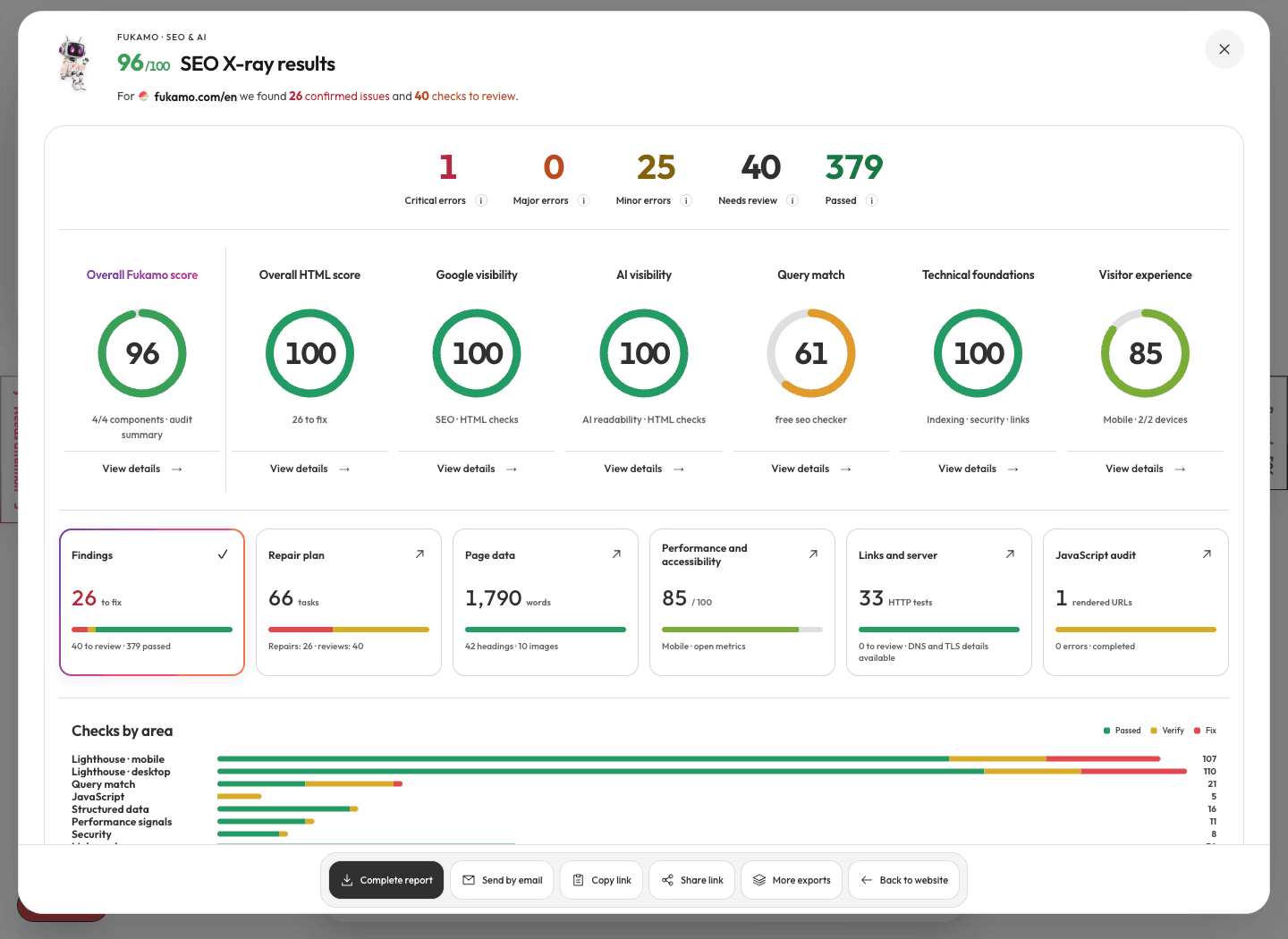
How to choose the right structured data type
A service page does not become a product offer because you want a price in search results. Identify the page’s main subject before choosing its schema.
- Describe the actual article and author on an article page.
- Make BreadcrumbList reflect the navigation hierarchy.
- For a product, use the genuine offer, currency and availability.
How to check syntax, accuracy and rich result eligibility
Valid JSON does not establish factual accuracy or eligibility for a particular rich result. Each question needs its own check.
- Use a parser to check syntax, including commas and quotes.
- Compare declared properties with the visible page content.
- Check the intended feature’s own policies and required properties.
How to fix conflicting markup from themes and plugins
A theme may emit one Product while a plugin emits another with an old price. Multiple declarations are not automatically wrong, but contradictory properties need a shared source of truth.
- Inspect every JSON-LD block and any other markup formats.
- Derive price and availability from the data used by the visible offer.
- After an update, check the public response outside the administration cache.
Why valid markup does not guarantee a rich result
A successful test does not order a rich result. Google decides how to display supported features; invented reviews are never a legitimate way to complete fields.
- Fix errors relevant to the type you actually use.
- Add a recommended property only when you have an accurate value.
- After deployment, monitor the relevant Search Console report where available.
How to verify the result
Fukamo checks declarations in retrieved HTML. Verify factual accuracy and feature-specific requirements separately; search engines decide how results are displayed.
Primary documentation developers.google.com ↗
Frequently asked questions
Why did valid JSON-LD not produce a rich result?
Valid syntax, eligibility for a supported feature, and actual display are separate outcomes. Check Google’s requirements for the specific feature and match visible content. Never invent ratings, prices, or authors. Adding FAQ markup to an ordinary commercial website does not establish eligibility for an FAQ rich result.
When the task is complete
JSON-LD parses, describes the actual page, and agrees with visible information. Use the appropriate test for supported features; Google still decides whether to display them.
Related SEO guides
Check a specific page.
Fukamo shows findings, evidence and the next step.
679 rules + SEO, AI readability, performance and accessibility measurements for free.