Why does a local fix still fail in the production audit?
Reproduce the problem in the same environment. Cache, middleware, a CDN or client rendering can explain differences between local code and a public scan.
What to do step by step
- Record the exact URL and audit time.
- Compare HTTP response, source HTML and rendered DOM.
- Find the shared component or metadata source.
- Specify the expected result and a case that must remain unchanged.
- Verify production and related variants after deployment.
A practical example
Acceptance. The service returns 200, its own canonical and an H1 in HTML. An unknown slug still returns 404. Success is not defined only by a higher score.
A common mistake
Hiding an element from the scanner is not fixing its cause. Do not weaken server protections just to turn a test green.
Try the report before checking your site.
Explore the sample report, then enter your own URL to see findings, HTML evidence and a repair plan for your page.
Run your audit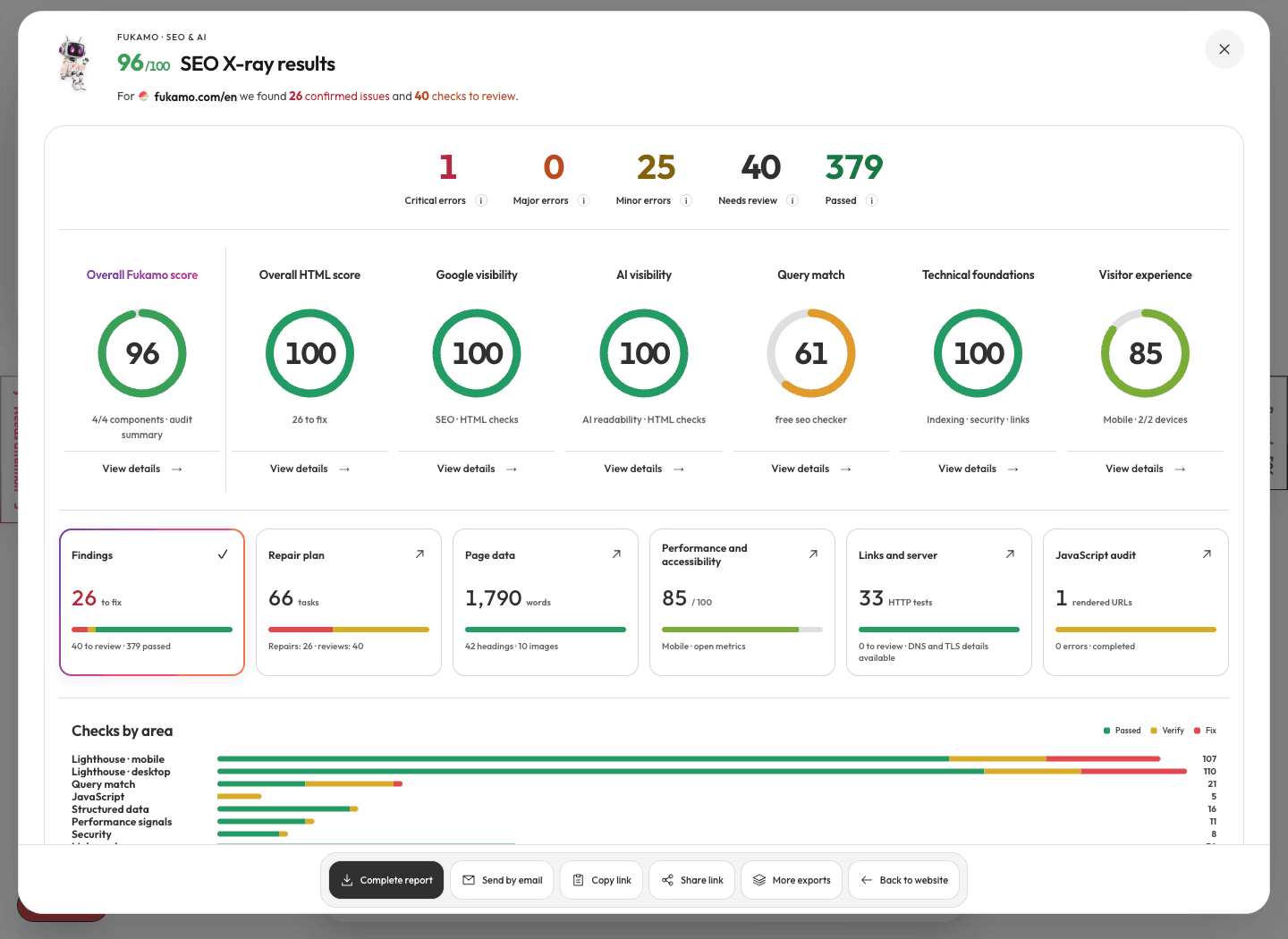
How to reproduce the public response behind a finding
Keep the complete URL, time and environment. A description that appears after menu navigation but disappears on direct entry may depend on client state.
- Record query parameters and selected language.
- Compare direct entry with in-app navigation.
- Keep private request data out of public tickets.
Is the SEO problem in HTTP, HTML or the rendered DOM?
HTTP, delivered HTML and rendered DOM provide different evidence. A screenshot cannot establish the original response, and an HTML check cannot explain every interaction.
- Read status and indexing headers.
- Inspect metadata and the main answer in the response.
- Compare browser rendering when content depends on scripts.
How to write an SEO acceptance test
Replace “improve canonical” with the exact expected destination. Check the destination exists and still matches the page’s subject.
- Include an unknown slug or empty result.
- Preserve intentional noindex and private access.
- Test an unaffected route after changing shared logic.
What to check after deploying an SEO fix
If the fix exists locally but not publicly, check release, generation time and cache before making another edit. Correct configuration must reach the relevant code path.
- Inspect an ordinary unauthenticated response.
- Record the cause and final verification URL.
- Retest relevant shared-template samples.
How to verify the result
Run the acceptance test against the public response, then test the negative case and another route using the shared component. Record cache state when it changes the response.
Primary documentation developers.google.com ↗
Frequently asked questions
Why does a local fix still fail in the production audit?
Verify the exact production URL, release, cache, and unauthenticated response. Another template layer or HTTP header may override metadata. For client rendering, compare the server document with the DOM; a screenshot cannot establish every indexing signal.
When the task is complete
The reproduction fails before the fix and passes against the deployed response afterward. Test error paths and related templates to catch regressions outside the original URL.
Related SEO guides
Check a specific page.
Fukamo shows findings, evidence and the next step.
679 rules + SEO, AI readability, performance and accessibility measurements for free.