What does a one-URL audit cover, and when do I need a site crawl?
Choose a service, product or article and record what a visitor should accomplish there. Add another example of the same template to identify shared defects.
What to do step by step
- To check retrieval, open the public URL while signed out, note HTTP status and redirects, and inspect robots.txt for the path. A service page should deliver the intended content at its preferred address.
- To check indexing, inspect the URL in Search Console. Compare the recorded crawl, indexing permission and Google-selected canonical. Use the live test for the current response; the saved report describes the previous crawl.
- To inspect the page, run Fukamo for the URL and intended search phrase. Compare the title, H1, opening answer and canonical with the actual service or product. Read the evidence for each failure.
- To test navigation, open the internal links leading to the page and the links leaving it. Check broken destinations, descriptive link text and whether related services can be reached. Sample another page using the same template.
- To measure the experience, review Lighthouse laboratory results and available Core Web Vitals field data separately. Test the booking or purchase path on mobile and with a keyboard. Save a missing measurement as a follow-up task.
- To prepare repairs, separate confirmed defects, decisions requiring context and missing evidence. Give each task a URL, rule or observation, proposed change and acceptance check. Retest the same inputs after publication.
How to turn an SEO audit finding into a fix
Teaching example; example.com addresses are illustrative.
Before
<title>Bicycle repair</title>
<main><p class="title">Bicycle repair</p></main>
After
<title>Bicycle repair</title>
<main><h1>Bicycle repair</h1></main>
Before the change, h1-present reports 0 H1. Developer task. Change the element in the service template while retaining the design. Acceptance. Fresh public HTML includes the H1 and the same check passes. Keep a canonical requiring a decision and an unavailable Lighthouse run in separate work queues.
A common mistake
A clean homepage can hide broken product or article templates. Include at least one important URL of each type in a wider audit. Check backlinks and competitors with a separate data source when those questions affect your plan; Fukamo’s single-URL report does not measure that coverage.
Try the report before checking your site.
Explore the sample report, then enter your own URL to see findings, HTML evidence and a repair plan for your page.
Run your audit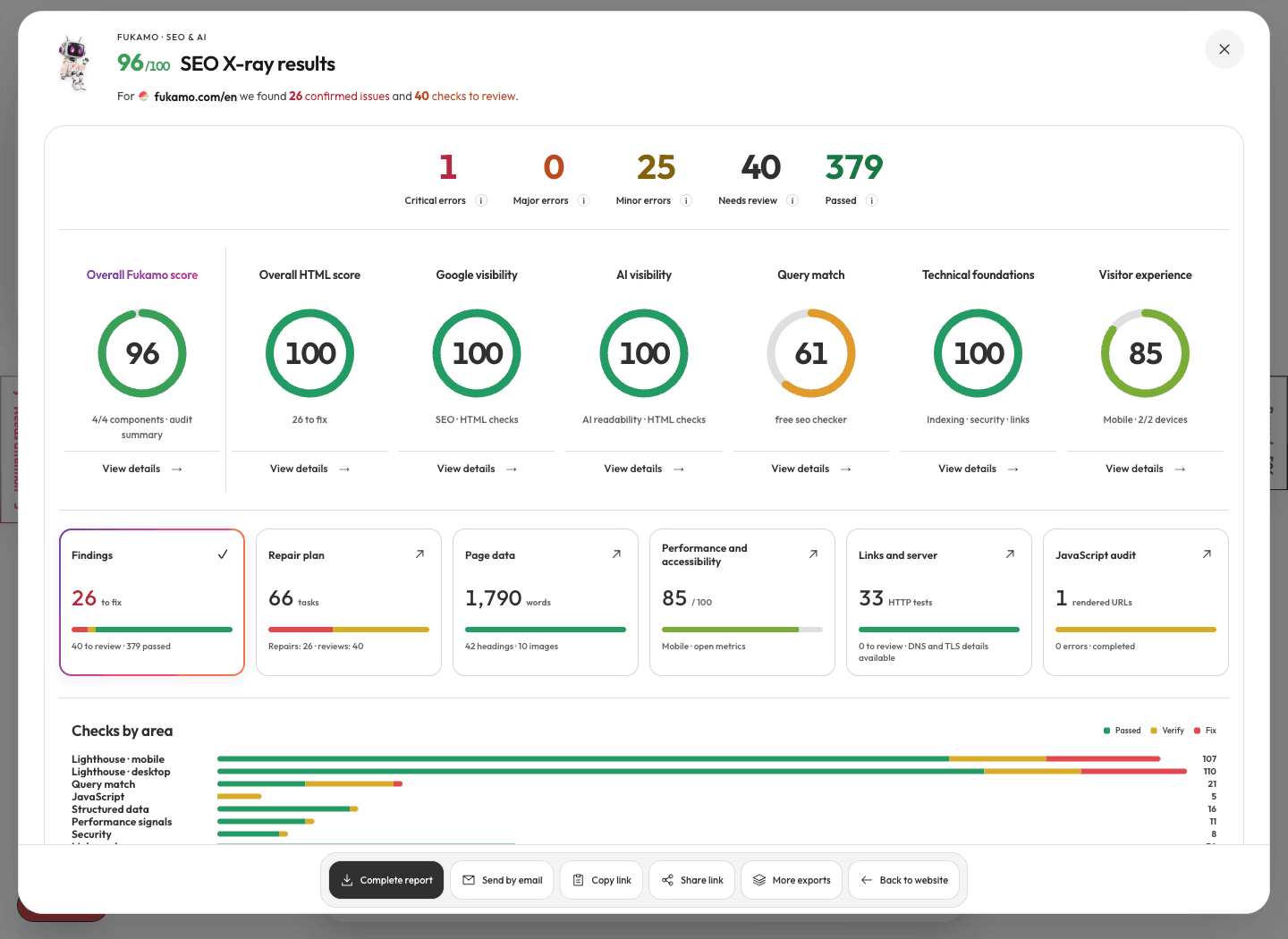
Which page should you audit first?
Choose one service, product or article and name the visitor’s task. Record the audit scope before scanning; a single URL result describes the response obtained for that page.
- For a service, ask whether a visitor can find the price, conditions and booking route.
- Add another URL using the same template and an edge case, such as a product without a photograph.
How to confirm what the audit fetched
Before fixing findings, compare the final URL, HTTP status and main text. A 200 response can still contain a security challenge instead of the requested article.
- Compare missing content in the server HTML with the ordinary browser page.
- Check indexing in your own Search Console account; the public scan cannot access that account.
How to turn findings into repair tasks
Separate confirmed errors, contextual reviews and unavailable evidence. A shared template defect can explain several occurrences; compare pages before assigning a common cause.
- For a missing H1, check whether the service name exists but the template outputs it as a paragraph.
- For a canonical, first choose the preferred product version; a different address alone does not reveal the business intent.
How to verify a deployed fix
A task needs the URL, rule identifier, original evidence and expected change. After deployment, repeat the same check on the public page.
- Test another page using the repaired template and a previously passing example.
- Record technical completion immediately; compare visits and orders separately over a suitable period.
How to verify the result
Retest each repaired URL and compare the original evidence with the new response. Complete the visitor’s task again, such as booking a repair. Follow changes in Search Console over comparable periods after recrawling, keeping technical completion separate from traffic and business outcomes.
Primary documentation developers.google.com ↗
Frequently asked questions
What does a one-URL audit cover, and when do I need a site crawl?
One URL exposes document-level problems and initial evidence about its template. It cannot reveal every orphan page, duplicate, or path through a catalog. Start with a commercially important page, fix confirmed causes, then expand the sample to categories, products, and articles.
Is auditing the homepage enough?
No. Homepages, categories, products and articles may use different templates. Check a representative of each important page type. For a migration or a widespread issue, combine a broader crawl with Search Console data.
How often should I repeat an SEO audit?
Retest affected URLs after changing templates, navigation, redirects or indexing rules. Schedule routine checks according to how often the site changes. Compare each retest with saved evidence so that you can verify a specific repair.
When the task is complete
The output identifies the audited URL, distinguishes failures from reviews, and supplies evidence and next steps. Whole-site coverage needs its own inventory of visited and excluded URLs.
Related SEO guides
Check a specific page.
Fukamo shows findings, evidence and the next step.
679 rules + SEO, AI readability, performance and accessibility measurements for free.