Does missing source text prove Google cannot read it?
Separate content in the initial response, after rendering and after interaction. A price available only after a click differs from one loaded automatically. Check these states separately.
What to do step by step
- Compare the initial HTML with the rendered DOM.
- Find headings, descriptions, prices and links in both.
- Check whether content depends on a click, consent or login.
- Inspect script failures, blocked resources and API responses.
- Verify rendered output with a suitable URL inspection tool.
A practical example
Minimal shell: <div id="root"></div>
Useful initial content: <main><h1>Coffee machine repair</h1><p>Diagnostic service and repair intake.</p></main>
A common mistake
Google’s rendering capability does not prove every dependency will work. Conversely, missing text in a static scan does not prove that indexing is impossible.
Try the report before checking your site.
Explore the sample report, then enter your own URL to see findings, HTML evidence and a repair plan for your page.
Run your audit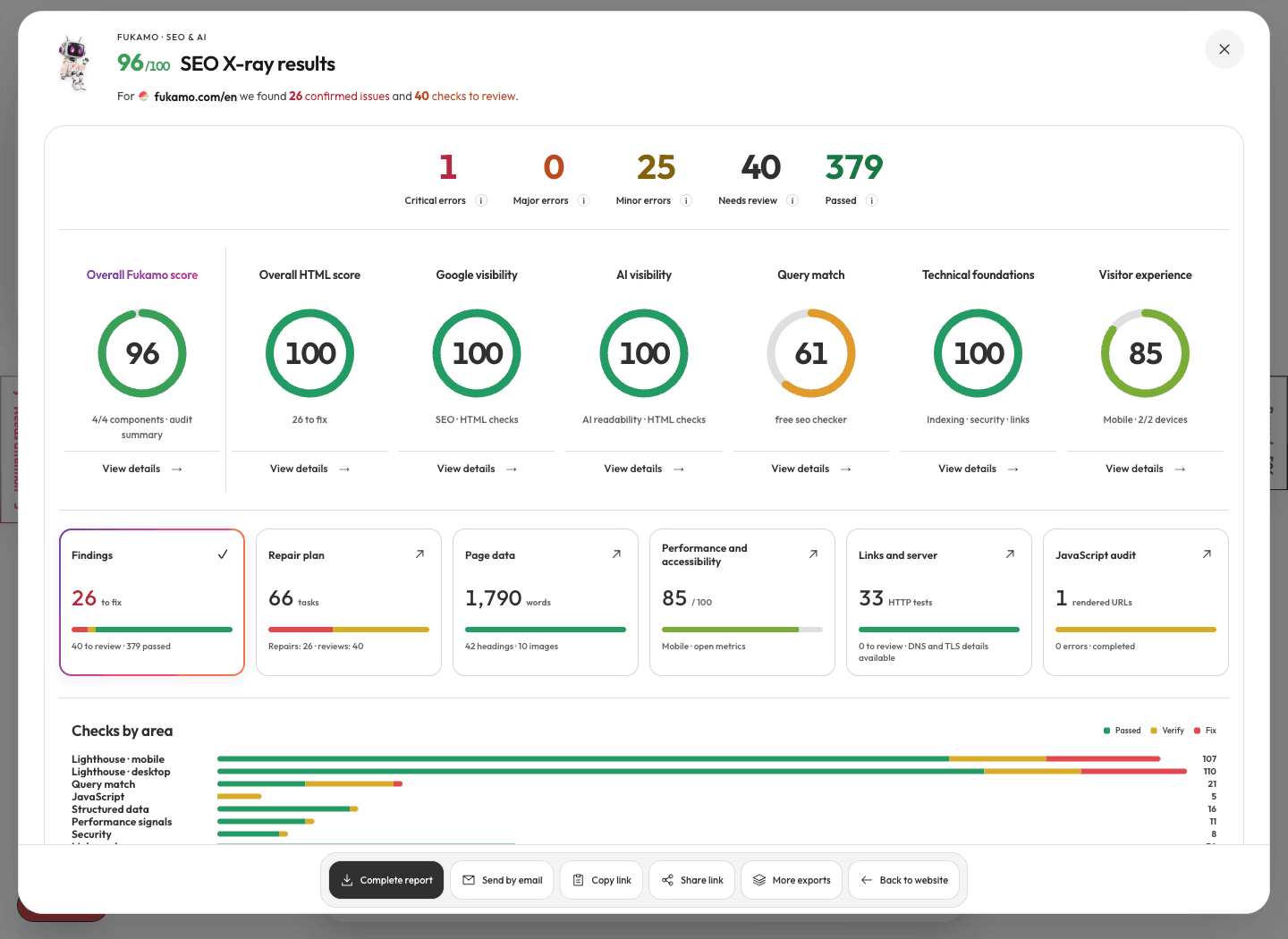
How to compare source HTML with rendered content
Save the initial HTML and the DOM after scripts run. Identify a specific difference, such as a price or heading, instead of labeling the entire site “invisible to Google”.
- Look for the main heading, offer and navigation in both versions.
- Separate content added by JavaScript from content missing after rendering too.
- Use URL Inspection to investigate Google’s rendering rather than assuming your browser is identical.
How to test direct page visits and failed dependencies
A product can work after clicking from a category but fail when its URL is opened directly. That difference gives the developer a useful reproduction.
- Open the detail in a fresh session without stored state.
- Test a slow or failed content API and record what remains visible.
- Check whether essential information waits for a click, login or optional-cookie consent.
How to check links and metadata after navigation
A clickable card is not enough if its destination exists only inside a script. Use a real link for navigation, then verify the page identity after the transition.
- Check internal links. A navigation element <a> needs a usable href.
- Move between two details and check title, canonical and H1 each time.
- Reload the second detail directly to catch stale client-side metadata.
When to consider server-rendered content
A stable guide may suit prebuilt HTML; changing availability needs an update strategy. Choose server rendering, generation or a smaller client repair from the observed failure, not fashion.
- Deliver important public content in the initial HTML where practical.
- Keep HTML and rendered prices or availability consistent.
- In Fukamo, inspect JavaScript audit results and their resource failures; an incomplete render needs review.
How to verify the result
Use Fukamo’s JavaScript audit to compare source HTML with the rendered result when that measurement completes. Check its scope and failures, then manually test interactions and verify Google’s view in Search Console.
Primary documentation developers.google.com ↗
Frequently asked questions
Does missing source text prove Google cannot read it?
Not automatically. Compare the server response, rendered DOM, and Search Console rendering. Content may depend on an API, consent, interaction, or a failing script. Delivering important information in HTML reduces those dependencies, but a static scan alone cannot prove Googlebot rendering failure.
When the task is complete
Opening the URL directly must expose the main content and links without prior navigation. Test a slow network and API failure so the page does not remain an endless successful-status loading screen.
Related SEO guides
Check a specific page.
Fukamo shows findings, evidence and the next step.
679 rules + SEO, AI readability, performance and accessibility measurements for free.