Which SEO terms are most often confused?
Separate observation from interpretation. A tag’s presence does not prove its value is right, and crawler access does not establish search visibility.
What to do step by step
- Crawling is how a bot retrieves pages.
- Indexing adds content to a search engine index.
- A canonical is the preferred URL for duplicate or similar content.
- Noindex is an instruction the crawler must be able to retrieve.
- Hreflang links equivalent language or regional versions.
- Anchor text is the label that helps explain a link destination.
- CTR is clicks divided by impressions. A SERP is a search results page.
A practical example
A sitemap lists a URL whose canonical points elsewhere. The sitemap helps discovery; it does not prove the listed URL was selected as an independent result.
A common mistake
Audit scores are not a standard unit shared by all tools. Different rules, weights and coverage can produce different numbers for the same site.
Try the report before checking your site.
Explore the sample report, then enter your own URL to see findings, HTML evidence and a repair plan for your page.
Run your audit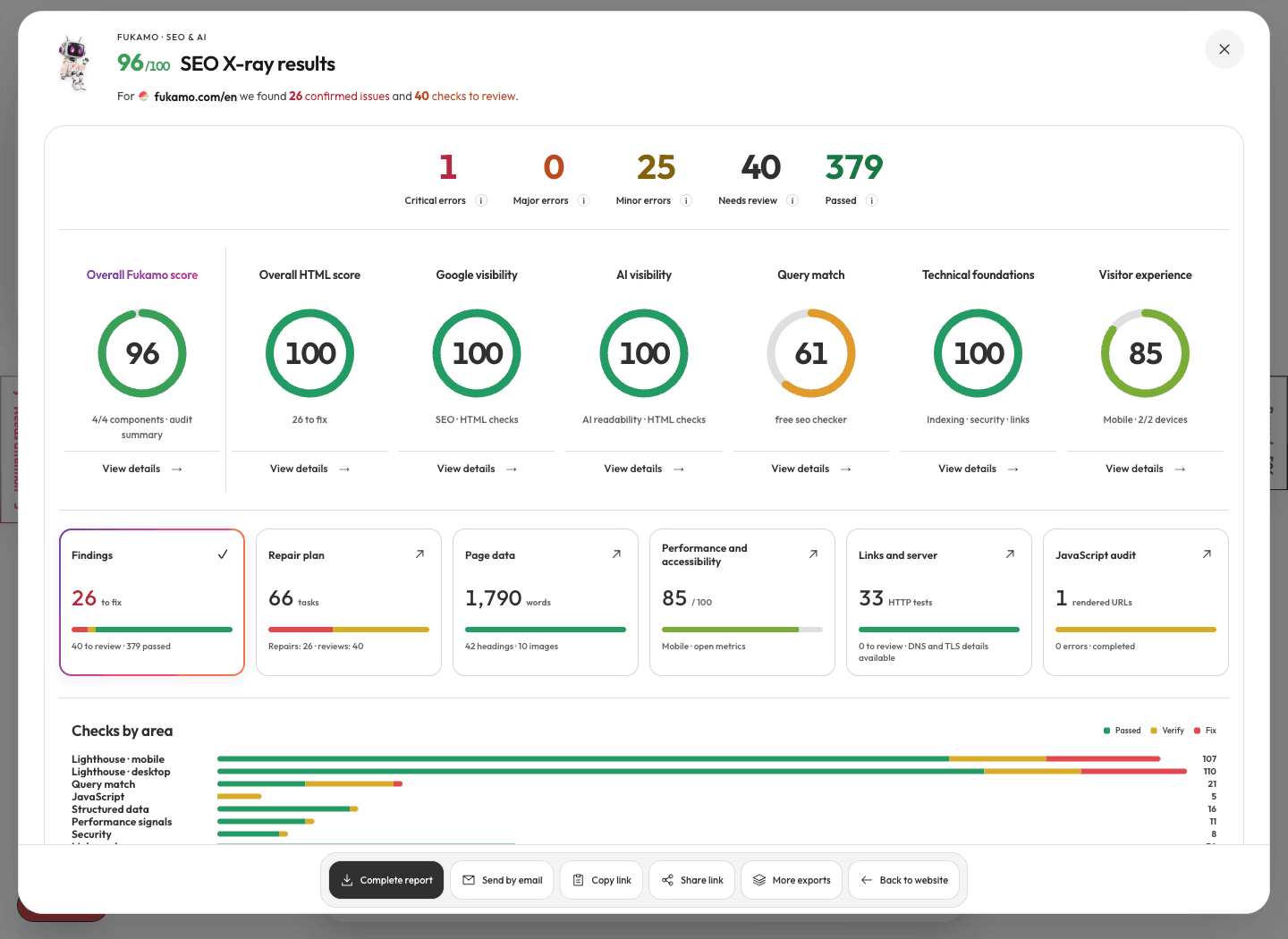
What is the difference between crawling and indexing?
A search engine can know a URL, fetch its content and then decide whether to include it in its index. Each step has a different outcome and verification method.
- Crawling means fetching; rendering means constructing the page, including processing supported JavaScript.
- Indexing means inclusion in the index. An accessible page may still be absent from it.
Source Google — how Search works ↗
What do robots, noindex and canonical mean?
These terms concern different decisions about access and addresses. Before editing, decide whether a page should be fetched, appear in search or be replaced by another URL.
- Robots.txt controls crawling and noindex controls exclusion from indexing; the crawler must be able to fetch the noindex instruction.
- A canonical identifies a preferred version of similar content. A redirect sends the request to another address.
Source Google — canonical URLs ↗
How do a title, H1 and anchor text differ?
The title names the document and the H1 is its main content heading. A snippet is a search-result preview; anchor text is the wording of a clickable link.
- “Bicycle repairs in Leeds” as a title and “We repair your bicycle” as an H1 can describe the same offer.
- “Repair prices” explains a link’s destination better than “Here” alone.
What do impressions, clicks and conversions measure?
Impressions describe appearances in search and clicks describe visits from results. CTR is clicks divided by impressions. Define a conversion around the website’s actual goal.
- Ten clicks from 100 impressions produce a 10% CTR. This is an illustrative calculation.
- Track a telephone-link click separately from a completed call or confirmed order.
How to verify the result
Ask what was measured, where the data came from and how a fix can be confirmed. Request that context before acting on an ambiguous label.
Primary documentation developers.google.com ↗
Frequently asked questions
Which SEO terms are most often confused?
Crawling retrieves content, indexing processes it into an index, and ranking positions it for a specific query. An impression is not a click, and a click is not a customer. A canonical signals a preferred version; a redirect actually sends the visitor to another address. These distinctions change the correct fix.
When the task is complete
Identify the outcome being measured and the evidence supporting it. Use a successful HTTP test as evidence of availability, not proof of indexing or sales.
Related SEO guides
Check a specific page.
Fukamo shows findings, evidence and the next step.
679 rules + SEO, AI readability, performance and accessibility measurements for free.