Indexability Checker
Check technical indexing barriers; verify actual Google indexing in Search Console.
What does Search Console say?
Guidance based on your selection. This tool does not access Search Console.Why is a page returning 200 still missing from Google?
First decide whether the URL belongs in search. A product and a cart serve different purposes. Then establish whether Google has not discovered it, cannot retrieve it or has not selected it for indexing.
What to do step by step
- Inspect the final URL in Search Console.
- Read the specific exclusion reason and distinguish crawling from indexing.
- Check status, crawler access, meta robots and X-Robots-Tag.
- Compare the declared canonical with the Google-selected version.
- Add a relevant internal link and request reprocessing after fixing the cause.
How to remove an unwanted noindex after launch
Teaching example; example.com addresses are illustrative.
Before
<meta name="robots" content="noindex, follow">After
<meta name="robots" content="index, follow">For a page intended for search, remove noindex from HTML and any X-Robots-Tag response header. Repeat the directives check and Search Console’s live test. Google’s recorded status confirms actual indexing afterward.
A common mistake
A site: search is an approximate diagnostic, not a complete index inventory. Repeated submissions do not make thin content more useful.
Try the report before checking your site.
Explore the sample report, then enter your own URL to see findings, HTML evidence and a repair plan for your page.
Run your audit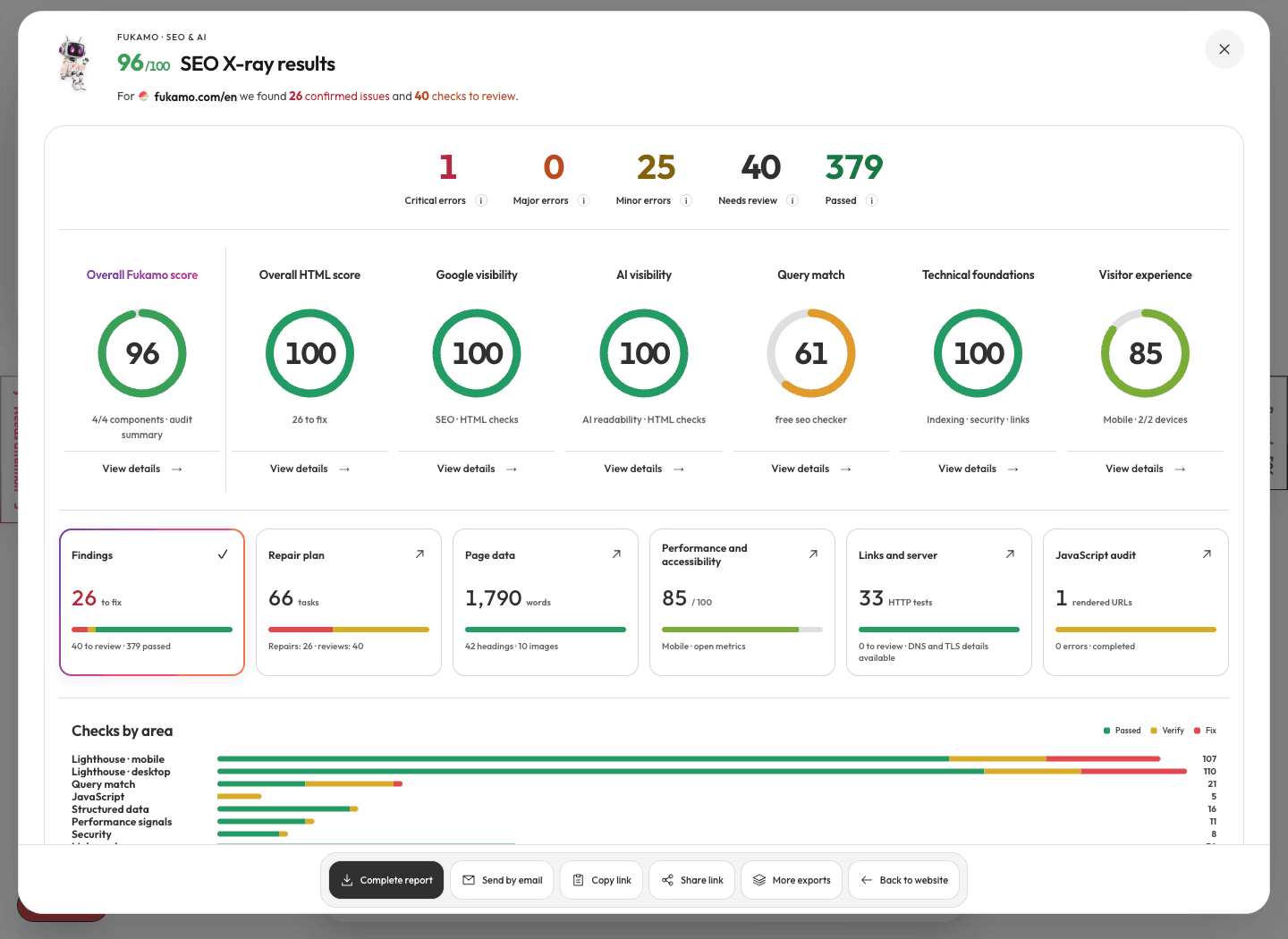
How to find the indexing exclusion reason in Search Console
Use URL Inspection for the exact public address. Discovery, crawling and indexing are different stages; each needs a different next step.
- Unknown URL — check a relevant internal link and sitemap entry.
- Crawl failure — investigate the response and crawler access.
- Crawled but not indexed — inspect directives, duplication and the page’s distinct value.
When to keep a page out of the index
A service page and an order confirmation do not need the same indexing policy. Removing every noindex can allow indexing of pages that were correctly excluded.
- Write down which page types belong in search.
- Compare meta robots with the X-Robots-Tag response header.
- For a PDF, inspect its own response headers, not just the download page.
Checking redirects and canonical URLs during indexing diagnosis
An original article pointing to its category as canonical may have a template defect. A tracking variant pointing to the original article may be correct. Compare the documents before changing either declaration.
- Follow redirects to the actual final page.
- Check that the preferred destination is available and represents the intended content.
- Compare your declaration with Google’s selected canonical after a fresh crawl.
Live URL tests and Google’s last crawl
The live test checks the current page; the indexed record can describe an older crawl. A successful live test does not guarantee indexing.
- Compare the last crawl date with your deployment date.
- Request indexing after resolving the cause, rather than resubmitting an unchanged page.
- If the page remains excluded, inspect its specific reason again instead of adding filler text.
How to verify the result
Check the last crawl date after reprocessing. Fukamo can identify a technical obstacle in the response, but it cannot confirm Google’s indexing decision without the corresponding data.
Primary documentation support.google.com ↗
Frequently asked questions
Why is a page returning 200 still missing from Google?
A 200 response confirms delivery, not indexing. In Search Console, inspect the last crawl, indexing permission, and Google-selected canonical. Repeatedly requesting indexing will not fix a duplicate or a page with little distinct value. Keep the live availability test separate from the previously recorded index status.
How can I check whether Google indexed an exact URL?
Use URL Inspection in Search Console for the exact address. Distinguish the recorded index status from the live test. A live test checks current availability; it does not by itself establish that the URL is indexed.
Will submitting an XML sitemap help?
A sitemap helps Google discover preferred URLs. It cannot fix noindex, an incorrect canonical or missing content. Track the processing of individual pages after submission; a successfully fetched sitemap does not confirm indexing.
When the task is complete
Verify that the live test receives the intended content and directives. Confirm actual indexing separately after Google processes the page again. Neither acceptance nor a processing deadline is guaranteed.
Related SEO guides
Check a specific page.
Fukamo shows findings, evidence and the next step.
679 rules + SEO, AI readability, performance and accessibility measurements for free.