Redirect and HTTP Status Checker
Check the final HTTP status, redirect count and a sample of internal links.
Should every deleted page redirect to the homepage?
For a move, preserve the path to an appropriate replacement. Use 404 or 410 when removed content has no replacement. Treat a temporary server failure as an outage rather than permanent removal.
What to do step by step
- Record every redirect from the original URL.
- Compare the final response and destination with the original purpose.
- Remove loops and unnecessary intermediate steps.
- Update internal links to the final destination.
- Test host, protocol and migrated URL variants.
How to fix a redirect chain
Teaching example; example.com addresses are illustrative.
Before
/old-bike → 301 /bikes/old-bike → 301 /bikes/city → 200After
/old-bike → 301 /bikes/city → 200Point the first redirect at the final URL and update internal links. In the next scan, compare the redirect count and final destination; the final 200 alone hides the detour.
A common mistake
Sending every missing page to the homepage hides broken paths without providing a useful replacement. One successful request also does not exclude intermittent server errors.
Try the report before checking your site.
Explore the sample report, then enter your own URL to see findings, HTML evidence and a repair plan for your page.
Run your audit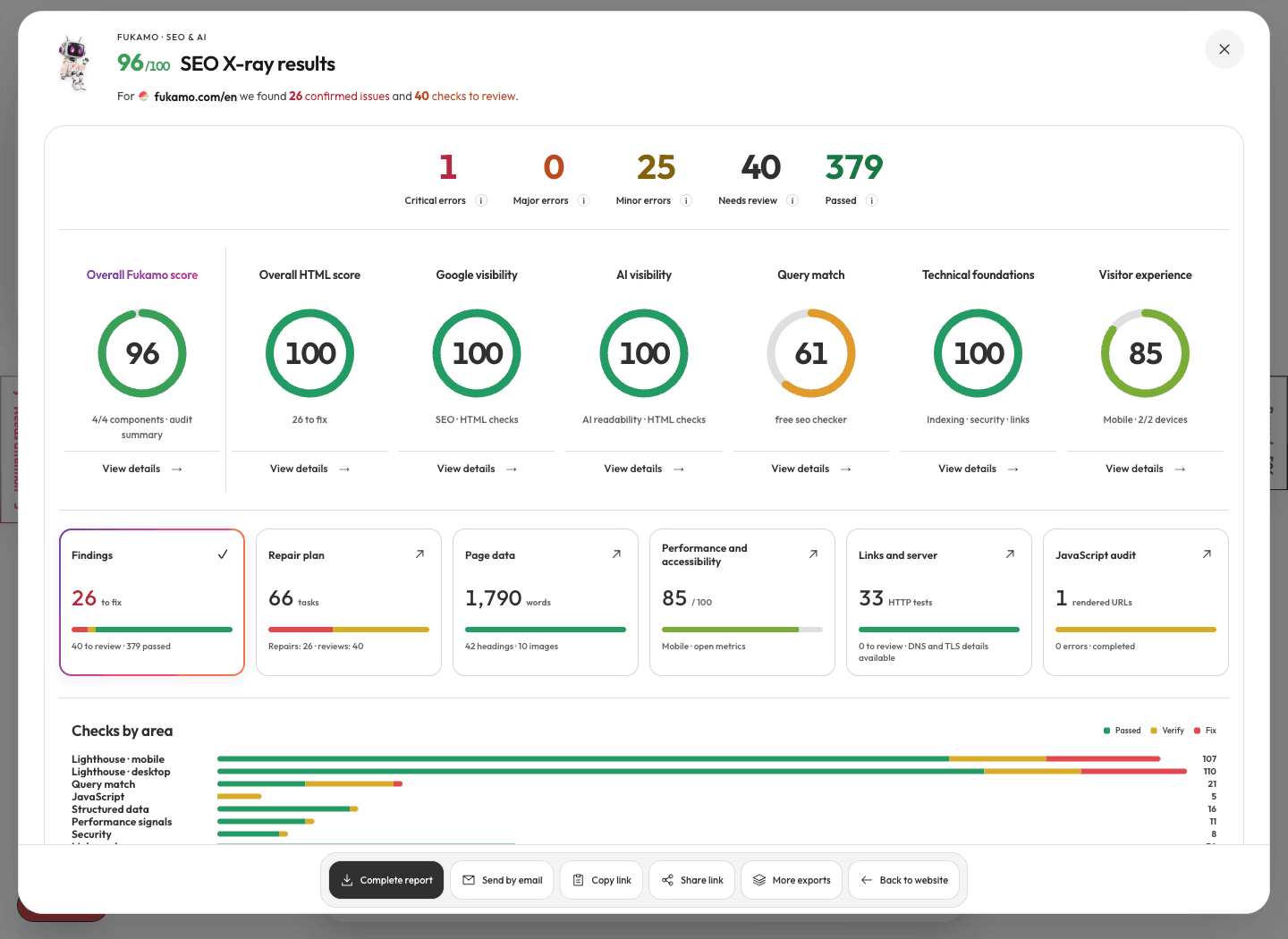
When to redirect and when to return 404 or 410
A discontinued product, a temporarily unavailable server and a renamed service are different situations. The response should describe what happened.
- Use 301 or 308 for a permanent move to an appropriate replacement.
- Use a temporary redirect when the original destination is expected to return.
- Use 404 or 410 for removed content without a meaningful replacement.
How to choose redirect destinations during a migration
A migration needs content-level decisions. Redirecting all old articles to the homepage may technically move visitors while losing the answer they came for.
- Pair each old page with the nearest equivalent content.
- Keep useful details when consolidating several articles.
- Test an unrelated old URL so a broad rule does not capture the whole directory.
How to fix redirect chains and loops
Test the original link, every hop and the final document. A redirect is not fixed if its destination loops, requires login or shows an error with status 200.
- Point known old addresses directly to the final target where possible.
- Update internal links instead of relying on redirects forever.
- Include HTTP/HTTPS, host and trailing-slash variants in the test set.
How to investigate recurring 5xx errors
A successful retry does not explain an intermittent 503. Keep the request time and path so the server owner can compare them with logs.
- Return a real 404 with helpful navigation on a missing page.
- Investigate recurring 5xx at the application, proxy and hosting layers.
- After migration, update the XML sitemap and retain old campaign URLs in your checks.
Source Google — HTTP status codes ↗
How to verify the result
Inspect response headers in a network panel or HTTP client. For recurring 5xx responses, compare timestamps with server logs rather than relying on one retry.
Primary documentation developers.google.com ↗
Frequently asked questions
Should every deleted page redirect to the homepage?
No. Redirect to a relevant replacement when one exists. For permanently removed content without a replacement, an appropriate error response is clearer than an unrelated homepage. A temporary server outage is also different from permanently removed content. The status should describe the actual situation.
When the task is complete
Inspect the full chain, final status, and destination relevance. Update internal links to the final URL. Test a nonexistent path to ensure the custom error page does not accidentally return 200.
Related SEO guides
Check a specific page.
Fukamo shows findings, evidence and the next step.
679 rules + SEO, AI readability, performance and accessibility measurements for free.