H1–H6 Heading Checker
Check H1 headings, empty headings and heading order in HTML.
Why does an obvious visual heading not appear in the audit?
Read the outline without the paragraphs. If its subject and sequence are unclear, fix the wording and hierarchy. The H1 count alone is not evidence of a search penalty.
If a heading appears in the browser but is absent from the HTML response, inspect JavaScript. If the heading contains only an image, supply alternative text or a visible text label. Verify accessibility by navigating the outline with a screen reader.
What to do step by step
- Read headings in document order.
- Check that H1 describes the specific page.
- Use H2 for its main questions.
- Use H3 for subtopics within a section.
- Inspect repeated components and hidden navigation.
How to add a missing H1 heading
Teaching example; example.com addresses are illustrative.
Before
<p class="hero-title">Bicycle repair</p>
<h2>Book a repair</h2>
After
<h1>Bicycle repair</h1>
<h2>Book a repair</h2>
The h1-present check finds 0 H1 elements before the change and 1 afterward. Keep the design through CSS and inspect the heading outline; font size alone does not create an HTML heading.
A common mistake
Turning every bold phrase into H2 makes the outline worse. Review skipped levels in context instead of rewriting content mechanically.
Try the report before checking your site.
Explore the sample report, then enter your own URL to see findings, HTML evidence and a repair plan for your page.
Run your audit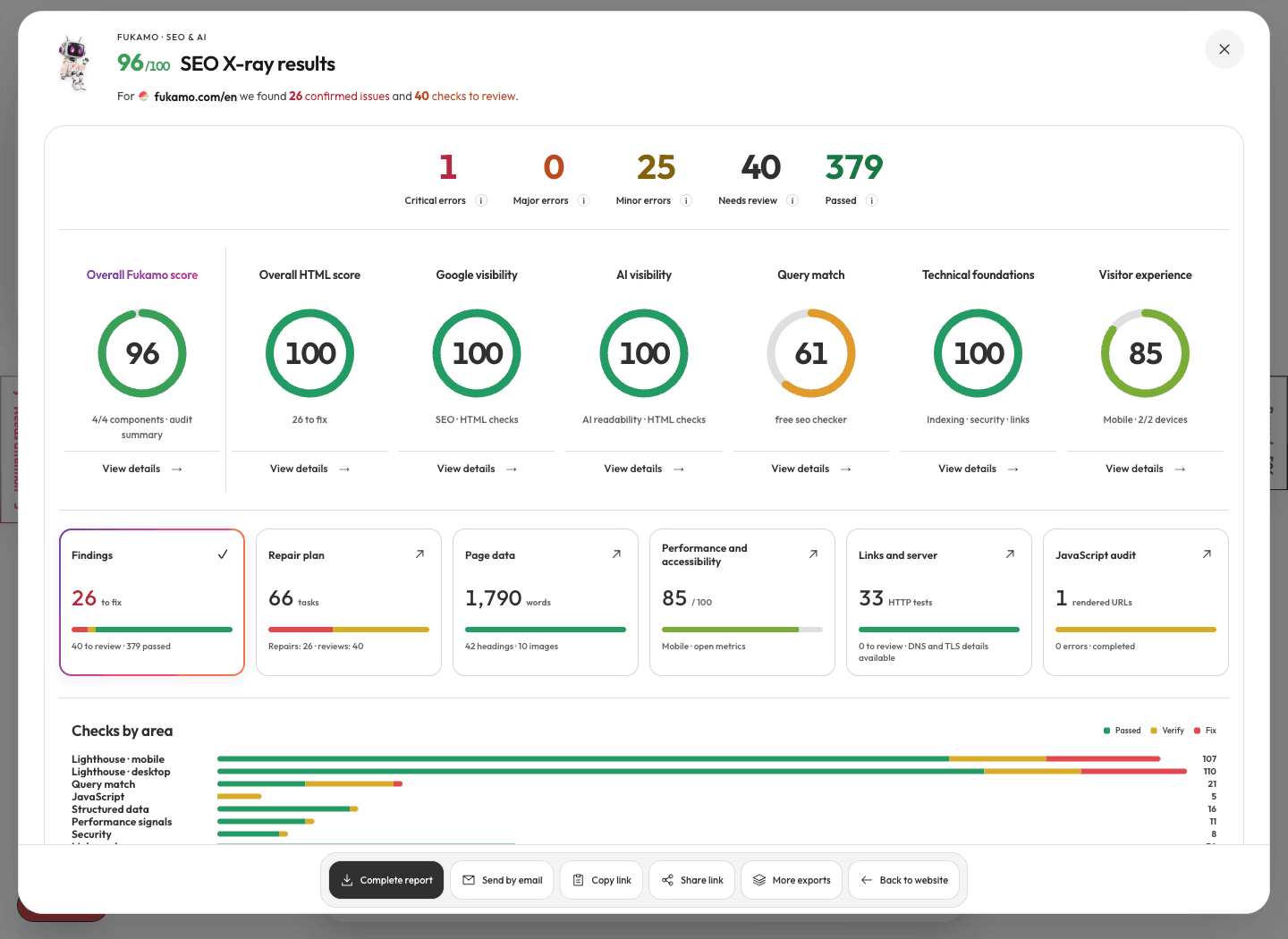
How to check your heading hierarchy
A heading list should explain the subject and sequence of questions. “More”, “Our offer” and “Further information” often conceal what their sections actually contain.
- Let the main heading identify this specific page.
- Use H2 for its main questions and H3 for their subtopics.
- Check each heading against the content that follows it.
Why heading rank is different from font size
A large promotional slogan is not necessarily a document heading. A small heading may identify an important subsection; adjust its appearance without changing its HTML meaning.
- Do not choose H4 simply because its default size looks right.
- Keep an emphasised sentence as a paragraph when it introduces no section.
- Check the mobile layout after changing the markup.
How to fix headings in cards and templates
A product card may sit below H2 on a category page but inside a deeper section elsewhere. A fixed heading rank in the component can produce an incoherent outline.
- Inspect card titles, navigation, the footer and the logo.
- Choose a reusable component’s rank according to its parent section.
- Do not remove a useful heading merely to satisfy an audit count.
How to test navigation by headings
A coherent outline also helps people navigate with a screen reader. Check the actual DOM order rather than relying on the visual arrangement of columns.
- Move through headings from the start to the end of the main content.
- Check whether a hidden mobile menu introduces unnecessary duplicates.
- After a template change, review an article, service and category page.
Source W3C WAI — headings ↗
How to verify the result
Read only the headings. If the page’s purpose and sequence are unclear, revise them. After a template fix, check other page types too.
Primary documentation www.w3.org ↗
Frequently asked questions
Why does an obvious visual heading not appear in the audit?
The text may be a div, an image, or a pseudo-element. Inspect HTML and the accessibility tree. If it names a section, use an appropriate heading and style it with CSS. Adding a hidden H1 just for points creates no useful outline. Readers and assistive technology need the same understandable structure.
When the task is complete
Reading the heading outline alone explains the page. Logos, banners, and repeated navigation labels do not obscure the main heading for the specific content.
Related SEO guides
Check a specific page.
Fukamo shows findings, evidence and the next step.
679 rules + SEO, AI readability, performance and accessibility measurements for free.